Ponding water
Standing water accelerates UV breakdown of the membrane and freezes into a wedge that stresses seams. Often traceable to a slope that was never quite right, or to a drain/scupper that clogged and re-routed itself.
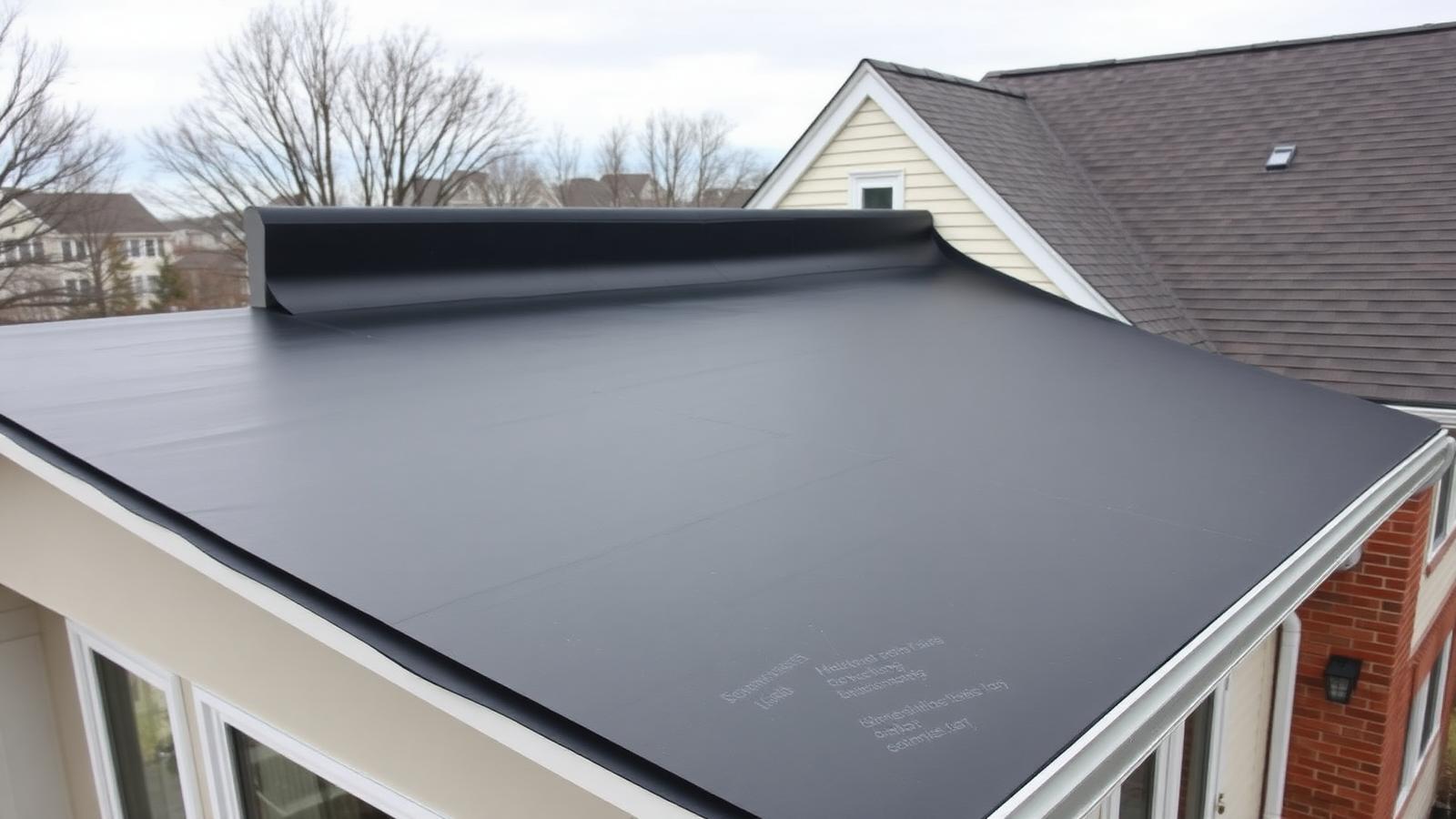
EPDM rubber, TPO membrane, and modified bitumen systems for porches, additions, dormers, and any section too flat for standard asphalt shingles. We install and repair the systems actually built for standing water and freeze-thaw cycling.
Very few Central New York homes are fully flat-roofed. What most homeowners are actually looking at is a low-slope section — a porch roof, a garage or addition roof, a dormer, or a bump-out over a bay window or kitchen — sitting next to the main steep-slope roof.
The technical threshold matters: roughly 2:12 and under (that's a 2-inch rise per 12 inches of run) is the low-slope zone where standard asphalt shingles are not code-appropriate and will fail early. If your section is in that range, it needs a proper membrane system — EPDM, TPO, or modified bitumen — engineered for water that doesn't shed the way it does off a steep roof.
Most of the failing flat sections we diagnose were built with the cheapest option the original builder had on the truck: three-tab shingles laid sideways, or ancient tar-and-gravel that's outlived its service life by a decade. Neither is what the section needs today.
For new installation or repair on a flat or low-slope section.
Ponding water, freeze-thaw cycling, and ice damming at the steep-slope transition are the four failure modes we see over and over. Each one calls for a different response.
Standing water accelerates UV breakdown of the membrane and freezes into a wedge that stresses seams. Often traceable to a slope that was never quite right, or to a drain/scupper that clogged and re-routed itself.
Older tar-and-gravel and brittle EPDM lose flexibility every winter. Once the membrane cracks, water gets underneath and lifts the whole system away from the deck.
Glued laps on older EPDM eventually let go. On TPO, delaminated heat-welds are the equivalent. Seam failures usually walk across a whole run rather than staying isolated.
Where the low-slope section butts against the main steep-slope roof, ice damming from the shingle roof above dumps meltwater onto the flat section — often faster than that section was ever designed to shed.
A single-ply black rubber membrane, adhered to the deck with lap adhesive at the seams. Long field track record, straightforward to repair, and forgiving of the small imperfections real houses always have. Our default recommendation for smaller residential sections — porches, garage additions, dormers.
A white single-ply thermoplastic membrane with heat-welded seams — a continuous plastic weld rather than a glued lap. Reflects heat, which matters on a sun-exposed section, and produces a stronger seam over the long haul. The right choice for larger sections or homes where energy load is a real concern.
Asphalt-based rolled roofing, torch-down or self-adhered. A workhorse system where the section geometry, penetrations, or existing detailing favor a thicker, more forgiving material over a single-ply membrane.
We don't install built-up tar and gravel on residential low-slope sections — the systems that replaced it are better in every way that matters. And we won't run three-tab or architectural shingles on anything under 2:12. Shingles rely on gravity-shed water; below that pitch, water sits in the lap and finds its way underneath. If we get to a job and that's what a customer expects, we'll walk through why it doesn't meet code and what will.
The typical low-slope job we're called out to isn't a whole-house flat roof — it's one section of an otherwise pitched roof:
Installed pricing in the Syracuse area, as a working range:
Where a specific job lands in that range depends on section size, tear-off complexity, whether tapered insulation is needed to correct slope, and the flashing and edge detailing required at the transition to any adjacent roof. Repairs are priced separately based on the diagnostic — we don't quote flat roof repairs sight-unseen.
All flat and low-slope work carries a written 10-year workmanship warranty covering installation defects — seams, flashing, terminations, and the transition detail. Manufacturer warranties on the membrane itself run longer and vary by system: EPDM and TPO typically carry 20 to 30-year material warranties depending on product line.
Realistic service-life ranges we stand behind: EPDM 20 to 25 years, TPO 20 to 30 years, modified bitumen 15 to 20 years. If someone is quoting you 40 or 50 years on a residential low-slope roof, ask to see the manufacturer's actual warranty document.
Failing flat sections often show up alongside other roof-side issues. Common companion work:
We install and repair flat and low-slope roofs across Onondaga County, including Syracuse, Liverpool, Cicero, Camillus, Manlius, Fayetteville, DeWitt, and Baldwinsville. See every location we cover on our service areas page.
Get a free, no-obligation estimate from Central New York's trusted roofing & gutter experts.